
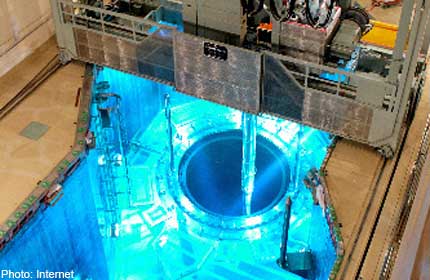
The Nuclear and Industrial Safety Agency has concluded five nuclear power plants have no active faults below their building sites.
NISA, the nuclear watchdog of the Economy, Trade and Industry Ministry, is looking into whether active faults exist below the sites of nuclear power plants nationwide. In a hearing of four experts held on Friday, the conclusion was reached that the five plants in question had no active faults below them, it said.
The five plants are: Kyushu Electric Power Co.'s Sendai plant in Kagoshima Prefecture and Genkai plant in Saga Prefecture; Shikoku Electric Power Co.'s Ikata plant in Ehime Prefecture; Japan Atomic Power Co.'s Tokai No. 2 plant in Ibaraki Prefecture; and Tohoku Electric Power Co.'s Onagawa plant in Miyagi Prefecture.
The experts examined whether faults below each plant's buildings could be subject to the following scenarios:
-- Cause quakes just below nuclear reactors.
-- Be pulled by active faults near the compounds and cause ground movement.
-- Cause ground movement from an earthquake that occurs in a distant place.
Based on past excavation survey results and other data, the experts concluded the five plants' sites are not susceptible to any of the three possible scenarios.
READ MORE...
Showing posts with label Shikoku Electric Power Co. and Kyushu Electric Power Co.. Show all posts
Sunday, August 12, 2012
Tuesday, May 29, 2012
Areas with nuclear plants may be exempt from rolling blackouts
The government and four electric companies are discussing the possibility of exempting areas around nuclear power plants from rolling blackouts that may be implemented this summer if power shortages become serious, sources said Tuesday.
The idea is to ensure that people living near nuclear power stations can evacuate quickly in case of problems at the plants, according to the sources.
The four utilities that may carry out rolling blackouts are Hokkaido Electric Power Co., Kansai Electric Power Co., Shikoku Electric Power Co. and Kyushu Electric Power Co.
Even though all of Japan's nuclear reactors are currently idle, spent fuel and other radioactive materials are stored inside the facilities, and work to cool the fuel continues.
In the event of a nuclear accident, it could be necessary to evacuate nearby residents, and it would be important to maintain communications around the plants so technicians and emergency responders would not be hindered, the sources said.
On the other hand, excluding areas around nuclear facilities from the rolling blackouts could trigger criticism. The government will thus carefully choose areas that would be exempted, the sources said.
Hospitals, water and wastewater service operators, and railroad operators will be exempt from the rotational power outages.
Last summer, rolling blackouts were conducted only in the Tokyo area, where there are no nuclear plants. Therefore, preparations for nuclear accidents were not necessary.
For this summer, the government has announced voluntary power-conserving targets in the areas served by the four power suppliers plus three other utilities — Chubu Electric Power Co., Hokuriku Electric Power Co. and Chugoku Electric Power Co.
If the rolling blackouts are used, power supply will be cut district by district, with each outage lasting two hours.
Power shortages are expected to be particularly serious in the Kansai region, where Kepco has relied heavily on nuclear energy.
The government is trying to win local support for the restart of the No. 3 and No. 4 reactors at Kepco's Oi power station in Fukui Prefecture.
Subscribe to:
Posts (Atom)